PharmagoraPlus Blog
Omnicell: Medication Automation
)
The healthcare sector is not spared …
In France, the healthcare sector is not immune to the problems affecting other public services, forcing healthcare professionals to do better and do more with limited financial resources:
- A reduction in the social security budget in 2023, even as every passing day reminds us just how much the healthcare system is suffering from a lack of funding.
- Aging population: Every year, the proportion of people over the age of 65 increases. By 2040, more than one in four residents is expected to be 65 or older*.
- An increase in outpatient care and a growing preference for home care—resulting in more patients taking their medications outside of designated medical facilities, with all the risks that entails, particularly medication errors. In France, the cost associated with medication-related iatrogenic events accounts for 10% of hospitalizations among those over 65 and 20% among those over 80**.
Automated PDA to address public health challenges
The National Academy of Pharmacy defines PDA as follows: “PDA (preparation of doses to be administered) involves preparing, when it contributes to better therapeutic care for the patient, personalized doses of medication to be administered in accordance with the prescription, and thus by planning in advance the sequence and timing of doses for a specified period. This method aims to improve adherence to and safety of treatment, as well as the traceability of its administration.”
For several years now, the PDA has established itself as an effective solution for patients requiring long-term and complex treatments. Several innovations have improved the PDA’s functionality, such as automation, which allows pharmacists to speed up the preparation of pill dispensers and drastically reduce the risk of errors in them. Furthermore, thanks to online health platforms, healthcare professionals can monitor and track medication use throughout the patient’s care journey. For example, using a digital prescription, a pharmacist can prepare a PDA in advance and then directly report the patient’s treatment progress to the attending physician and the health insurance provider.
PDA is also an excellent way to promote treatment adherence, given that only 40% of patients with chronic conditions are believed to follow their treatment regimen properly***.
PDA can also help reduce stockouts and waste, thereby cutting down on excess dispensing—estimated at 42.5 million euros—and thus waste****.
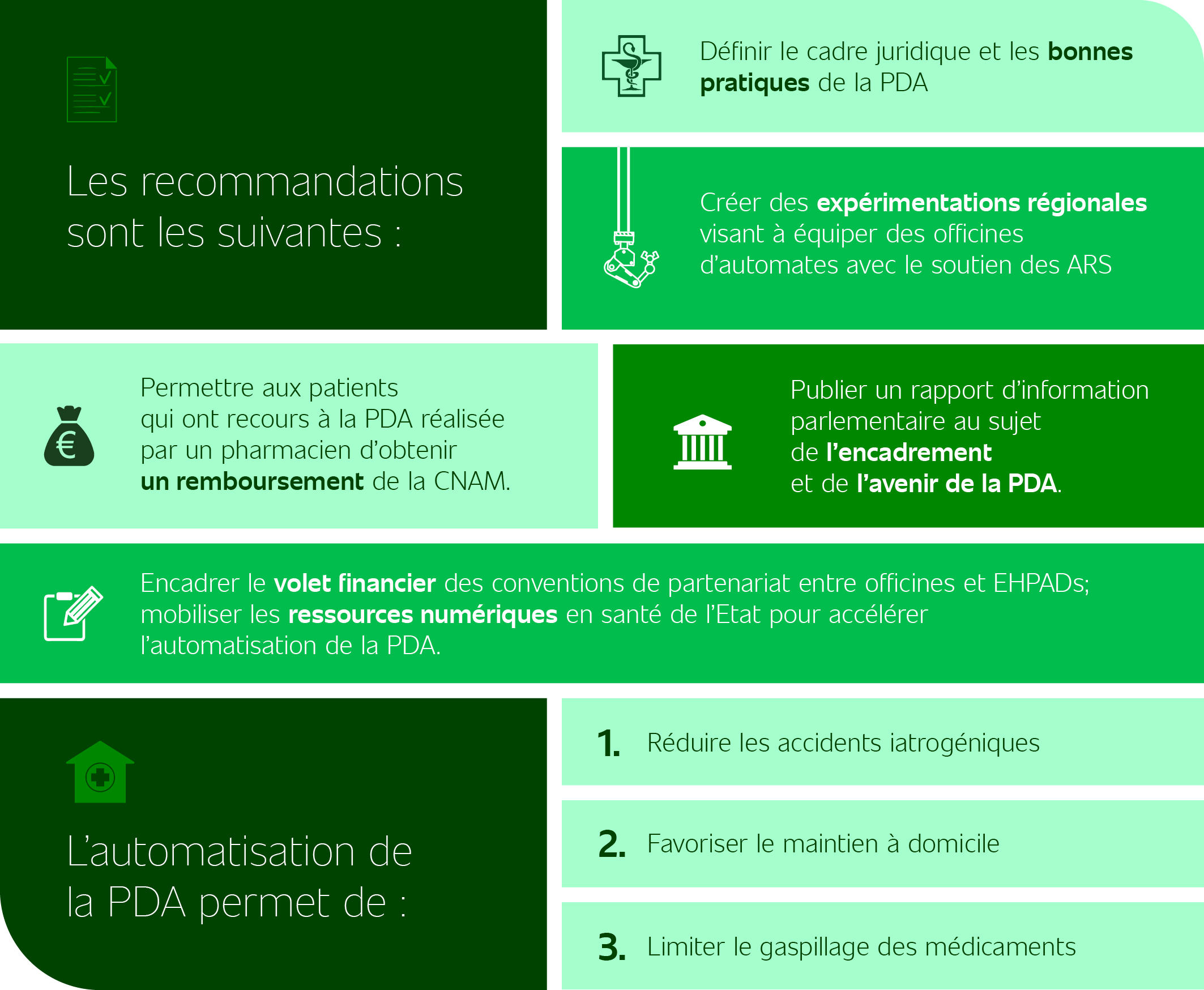
Yet today, certain obstacles still prevent professionals from realizing the full potential of automated dose dispensing: high capital costs, unclear regulatory frameworks, inconsistent prescription formats, and a process that is still not sufficiently valued by pharmacists. Omnicell therefore surveyed several experts, whose insights have been compiled in a white paper titled “Dose Preparation—How to Accelerate Automation for a More Resilient and Safer Medication Supply Chain for Patients.” It presents several recommendations that would help establish a clear framework for the use of automated dose preparation.
*Population by age − Tables on the French economy | INSEE
**HAS. How to Improve the Quality and Safety of Prescriptions for Older Adults. September 2014.
*** Pharma Magazine. Preparing Pill Dispensers. May 2020
****UNPF – Press Kit


















-(002).png)